Every worksite has a rhythm—equipment firing up, crews settling into tasks, supervisors scanning for risks. But one element too often treated as routine or rushed is the toolbox safety talk. When done poorly, it’s a box-ticking exercise. When done right, it prevents injuries, sharpens awareness, and builds a culture of accountability.
The challenge? Time, budget, and resources. That’s where free toolbox safety talks come in. They’re not just budget-friendly—they’re practical, actionable, and often created by safety professionals who’ve seen what works (and what doesn’t).
The best free talks aren’t just handouts. They’re structured, topic-specific, and easy to deliver—sometimes even with discussion prompts, checklists, or handouts. Whether you’re in construction, maintenance, utilities, or manufacturing, leveraging free safety talks saves hours while improving outcomes.
What Are Toolbox Safety Talks—And Why Do They Work?
Toolbox safety talks—also called tailgate meetings or safety briefings—are short, focused discussions held at the start of a shift or before a high-risk task. Typically lasting 5 to 15 minutes, they address a single safety topic relevant to the day’s work.
They work because they: - Target real-time risks (e.g., working at height, electrical safety) - Engage workers in dialogue, not passive listening - Reinforce policies without formal training overhead - Document safety communication for compliance
Unlike lengthy OSHA training modules, toolbox talks deliver bite-sized knowledge when it matters most. A talk on ladder safety before roof work, for example, is more memorable than a quarterly training session.
Common mistakes that kill effectiveness: - Reading directly from a script without interaction - Repeating the same topics monthly - No follow-up or accountability - Skipping talks during busy periods
Free toolbox safety talks solve many of these issues—when sourced from credible providers.
Where to Find High-Quality Free Toolbox Safety Talks
Not all free safety talks are created equal. Many are generic, outdated, or poorly formatted. The best ones come from trusted sources—government agencies, trade associations, or established safety organizations.
Here are five top sources for reliable, no-cost toolbox talks:
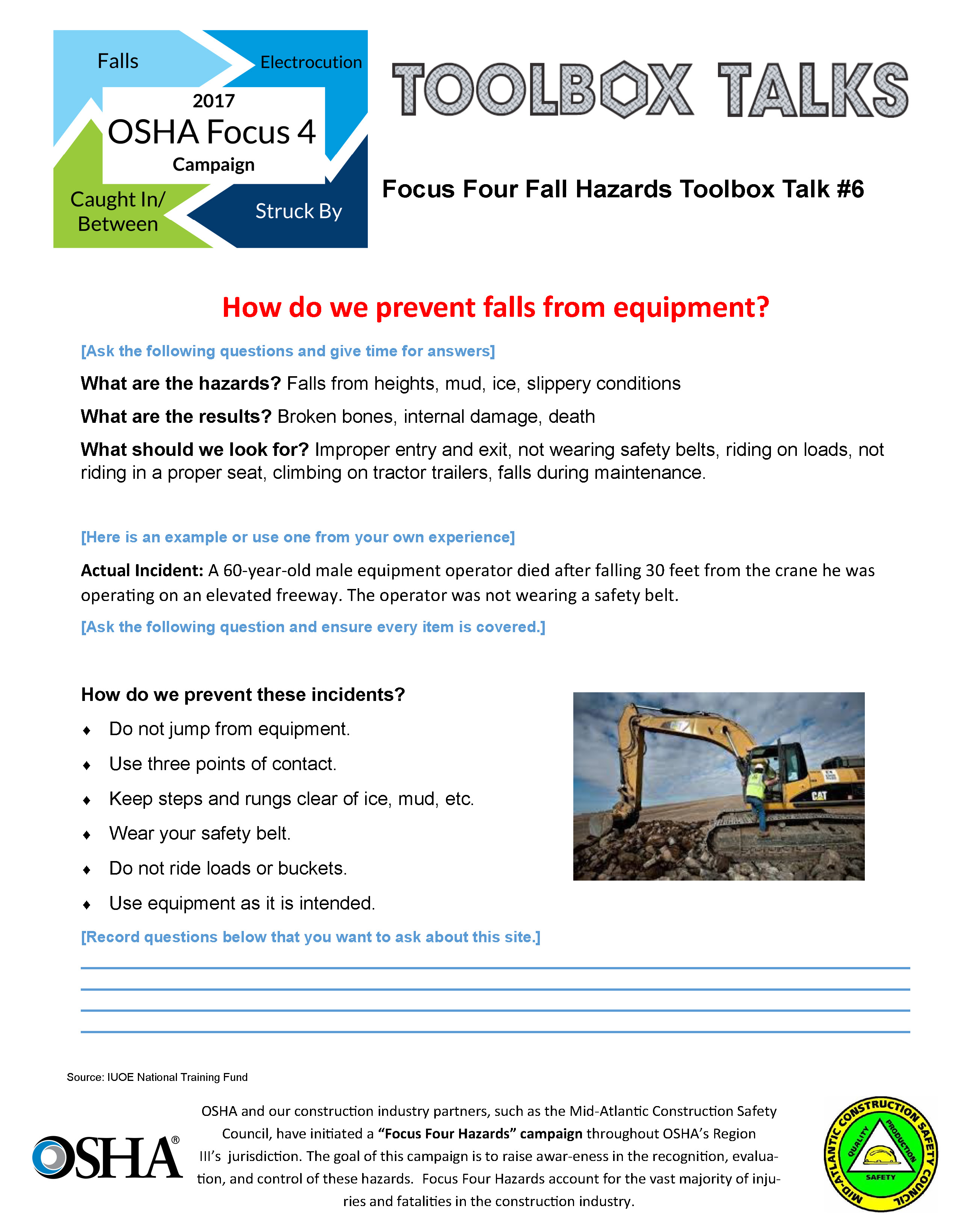
1. OSHA (Occupational Safety and Health Administration) The gold standard. OSHA provides free safety talk templates, fact sheets, and topic guides aligned with federal standards. - Strengths: Legally sound, OSHA-compliant, available in multiple languages - Best for: General contractors, public works, federally regulated sites - Sample topics: Fall protection, PPE, hazard communication
2. NIOSH (National Institute for Occupational Safety and Health) Focuses on research-backed safety practices, especially in high-risk sectors like mining, construction, and healthcare. - Strengths: Data-driven, includes infographics and worker handouts - Best for: Technical or hazardous environments - Sample topics: Silica exposure, heat stress, fatigue management

3. CPWR – The Center for Construction Research and Training Offers one of the most comprehensive free libraries of construction-specific safety talks. - Strengths: Industry-specific, available in English and Spanish, downloadable PDFs - Best for: Construction crews, subcontractors, multi-lingual teams - Sample topics: Excavation safety, scaffolding, crane operations
4. State and Local Safety Councils
Many regional bodies (like the National Safety Council affiliates) offer free, localized talks. - Strengths: Adapted to regional risks (e.g., winter work in the North, heat in the South) - Best for: Companies operating in specific climates or regulations - Sample topics: Winter driving, lightning safety, site traffic control
5. Trade Associations (e.g., ABC, AGC, NECA) Groups like the Associated Builders and Contractors (ABC) or National Electrical Contractors Association (NECA) offer members free safety resources—including toolbox talks. - Strengths: Niche expertise, updated regularly, often include sign-in sheets - Best for: Trade-specific teams (electricians, HVAC, roofing) - Sample topics: Lockout/tagout, confined space entry, arc flash
These sources avoid the fluff found in commercial templates. They’re designed for real crews and real worksites.
How to Deliver an Effective Free Safety Talk
Accessing free content is one thing. Making it stick is another.
Follow this workflow for maximum impact:
1. Match the Topic to the Day’s Work Don’t talk about forklift safety if no lifts are planned. Use the morning schedule to pick the most relevant topic. > Example: Crew installing roof vents? Deliver a talk on fall protection and ladder safety—using a free OSHA template.
2. Customize for Your Crew Even the best free talk needs local context. Add site-specific details: - "Last week, we saw loose guardrails on the north scaffold—today’s talk applies directly." - "Remember the incident at Site B? This is how we prevent that."
3. Engage, Don’t Lecture Ask open-ended questions:
- "What’s one thing you’ve seen this week that could lead to a slip or trip?"
- "How would you report a damaged harness?"
This builds ownership and reveals hidden risks.
4. Document Attendance Print a sign-in sheet or use a digital log. This proves compliance during audits. Most free templates from CPWR or ABC include ready-to-use attendance forms.
5. Follow Up Walk the site after the talk. Did crews put on gloves after the PPE talk? Did spotters appear during the forklift operation? Reinforce good behavior immediately.
Common Gaps in Free Safety Talks (And How to Fix Them)
Free resources save time, but they’re not perfect. Here are typical limitations—and how to overcome them.
❌ Generic Language
Many talks start with “All employees must…”—which doesn’t resonate. Fix: Rewrite to use direct, conversational language. > Instead of: “PPE must be worn at all times.” > Try: “If you’re near moving equipment, your hard hat and safety glasses aren’t optional—they’re how you go home safe.”

❌ No Visuals Text-only talks lose attention. Fix: Add a photo, diagram, or real-world example. Tape a picture of proper ladder setup next to the talk sheet.
❌ One-Size-Fits-All Format Some talks assume all crews have the same experience level. Fix: Adjust depth. For new hires, explain basics. For veterans, focus on near-miss stories or advanced controls.
❌ Missing Local Hazards A generic fall protection talk won’t cover your unique roof layout. Fix: Add a 30-second site-specific add-on. > “On this building, the parapet wall is only 28 inches—below OSHA’s 42-inch requirement. That means guardrails or fall arrest—no exceptions.”
Integrating Free Talks into Your Safety Program
Free toolbox talks shouldn’t be an afterthought. Plug them into a broader safety workflow.
Monthly Safety Planning At the start of each month, pull 4–5 free talks from OSHA or CPWR that align with upcoming projects. Schedule them weekly. > Example: > - Week 1: Trenching safety (for utility work) > - Week 2: Hand tool safety (for interior finish work) > - Week 3: Electrical safety (for panel upgrades) > - Week 4: Heat stress (as temperatures rise)
This builds consistency and covers critical topics systematically.
Rotate Safety Leaders Let experienced workers deliver a talk using a free template. It develops leadership and diversifies delivery style. Provide a 10-minute prep window and a printed guide.
Pair with Safety Audits
After a talk on housekeeping, perform a 5-minute site walk to check for clutter, tripping hazards, or unmarked spills. Immediate feedback reinforces the message.
Real-World Example: Preventing a Fall Incident
A mid-sized electrical contractor in Texas used a free CPWR toolbox talk on fall protection before starting roof-mounted solar installations.
They customized it: - Added photos of their own fall arrest gear - Discussed anchor point challenges on flat roofs - Asked workers to share past near-misses
Three days later, a worker noticed an unsecured edge on a new section. He stopped work and tagged it—citing the talk. No one was injured.
The company documented the talk, the near-miss, and the follow-up. During an OSHA inspection two months later, this record helped them avoid citations.
This wasn’t luck. It was free content, well-used.
Avoid These Free Talk Pitfalls
Even with great content, delivery can fail. Watch for:
- Over-reliance on free templates without customization
- Skipping talks during overtime or rush jobs—exactly when risks are highest
- No review or feedback loop—ask crews what topics they want
- Treating it as HR’s job—supervisors must own safety talks
Free doesn’t mean low-value. It means efficient.
Final Thoughts: Make Safety Accessible, Not Optional
Free toolbox safety talks are more than a cost-saving hack. They’re a force multiplier for safety culture. When you use quality templates from OSHA, CPWR, or trade groups, you’re not cutting corners—you’re scaling expertise.
The key is consistency, customization, and connection. Use free talks as a foundation, then adapt them to your people, your site, and your risks.
Start tomorrow: download one free talk, tailor it in 10 minutes, and deliver it with eye contact and a clear purpose. Repeat weekly. Track near-misses, injuries, and engagement. The data will show the difference.
Safety isn’t about budget. It’s about behavior. And behavior starts with a conversation.
FAQ
Where can I download free toolbox safety talks? OSHA, CPWR, NIOSH, and trade associations like ABC or NECA offer free, downloadable safety talks in PDF format.
Are free safety talks OSHA-compliant? Yes, if sourced from OSHA, CPWR, or NIOSH. These align with federal regulations and can be used for compliance documentation.
How long should a toolbox safety talk last? Aim for 5 to 15 minutes—long enough to cover the topic, short enough to maintain attention.
Can I modify free safety talks for my crew? Absolutely. Customizing content for your site, crew, and hazards improves relevance and effectiveness.
Do I need to document toolbox talks? Yes. Keep sign-in sheets or digital logs to prove training occurred during audits or inspections.
Should every supervisor run their own talk? Yes. Supervisors closest to the work should lead talks—they understand daily risks and crew dynamics best.
Are free talks available in Spanish? Yes. OSHA, CPWR, and many safety councils offer bilingual or Spanish-specific toolbox talks.